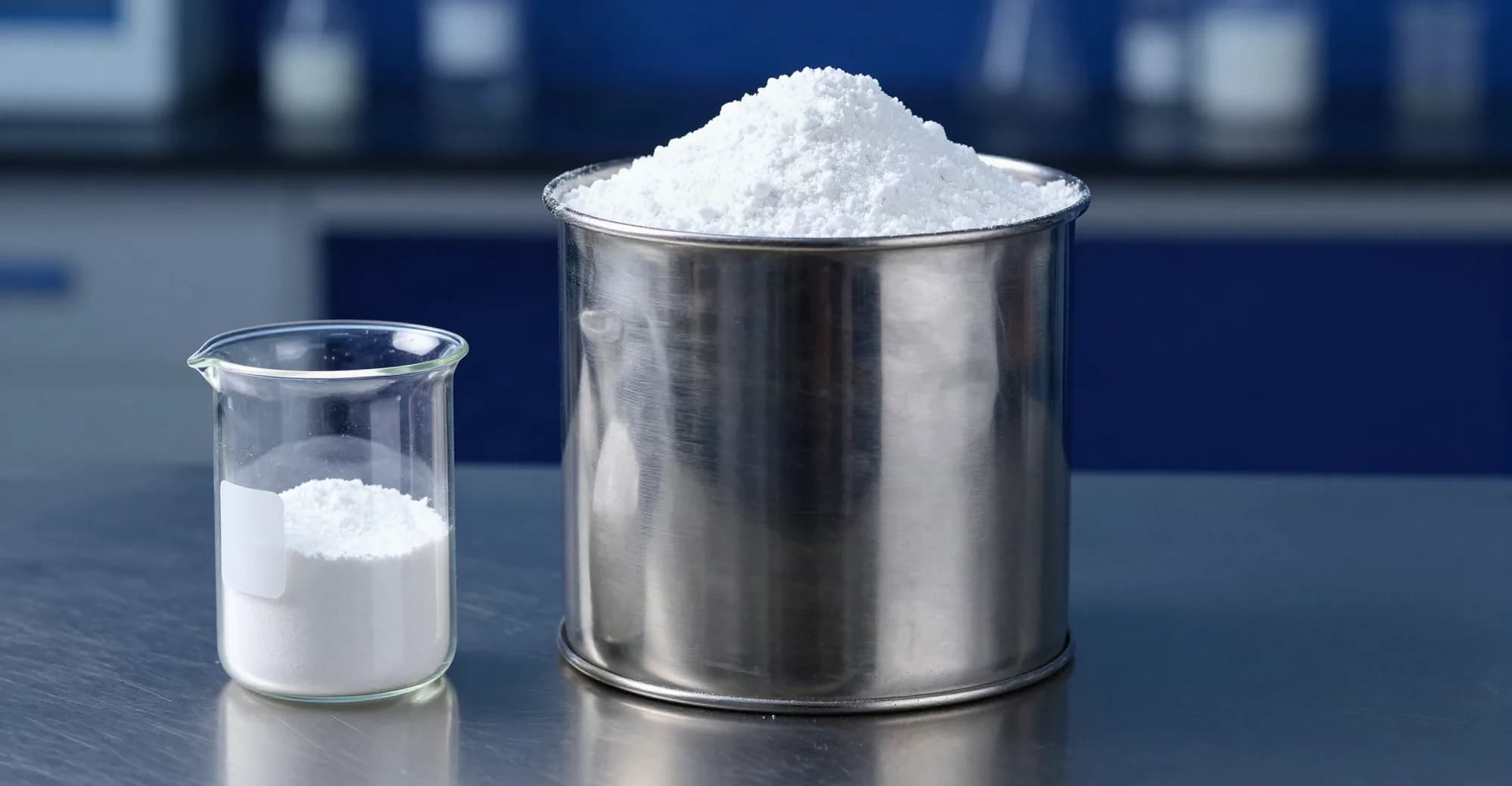
Scaling up a synthesis is not repeating the same recipe in a larger vessel: it is reproducing the specification under a different regime of mixing, heat transfer and time.
A material approved at bench scale reaches the project with a defined identity: phase, crystallinity, Ca/P ratio, particle size distribution and surface area. When that same material has to be produced in larger quantity, the nominal route stays the same — precursors, pH, temperature — but local conditions inside the reactor stop being uniform.
That is where the result changes without anything having changed on paper.
What changes when volume increases
At larger scale, mixing and heat exchange are no longer near-instantaneous. Gradients appear: regions of higher local supersaturation, points at a temperature different from the average, uneven residence times. In calcium phosphate precipitation, those differences show up in the product as variation in phase, crystallinity and particle size.
The effect is not proportional to volume. That is why scale transposition is a study of its own, not a multiplication.
The parameters that govern the transposition
The same parameters that control bench synthesis remain the controls at pilot scale, but they now demand explicit monitoring:
- pH and how it is corrected, because the local neutralisation rate drives nucleation.
- Precursor addition rate, which stops being negligible at larger volume.
- Agitation, which has to be described by mixing regime, not by stirrer speed.
- Reaction temperature and time, including heating and cooling, which become long.
- Post-synthesis steps — drying, milling, classification and thermal processing — where much of the variation is usually introduced.
The specification is what carries across
What crosses the change in scale is not the procedure, it is the specification. Before scaling, it is worth converting the approved material into declared ranges: phase and crystallinity intervals, Ca/P range, D10, D50 and D90, surface area, and a limit for secondary phases.
With the range defined, the question stops being subjective. It is not "the material looks similar", it is "the batch is within range".
Confirmation batches
A single successful pilot-scale run does not demonstrate transposition. The practice described in the literature on pilot-scale hydroxyapatite production is to produce a sequence of batches at the new scale and check whether phase purity, particle size distribution and powder behaviour repeat within range.
Three consecutive batches within specification say more about the process than one excellent batch on its own.
Conclusion
Scaling well means being able to state, with data, that the pilot-scale material is the same material approved at the bench — within a range declared beforehand, not adjusted afterwards.